

New Skill Sets for the Future: Skills You’ll Need to Stay Relevant in 2026
New skill sets people need in 2026 will be shaped by AI and social and economic changes. Human-centric skills like adaptability, creativity, resilience and lifelong learning will be essential for navigating a difficult job market.
AI and digitalisation are transforming the job market, and research shows core skills will change dramatically. While automation handles routine tasks, skills like problem-solving, critical thinking and communication remain irreplaceable and will help balance disruption with resilience.
This article explores how high-demand skills are changing the future of employment. Acquiring new skill sets can feel like stepping into uncharted territory, but it’s also a chance to push beyond our boundaries and strive for our best. In these changing times, it’s essential to rely on our strengths and personal values, and remember that our potential to adapt isn’t effortless, but it is timeless.
Job trends and core skills
While AI can read, process, and analyse documents and provide administrative support, it can’t replace direct care, high-level supervisory roles, or physical labour skills. A workplace forecast for 2026 indicates a decline in white-collar roles and an increase in blue-collar job opportunities. Entry-level positions in finance, law, administration and consulting are decreasing as AI takes over routine tasks like document processing.
According to a CEDEFOP survey, jobs for highly skilled workers are estimated to increase by 7 % around 2035. Employment of engineers and researchers is expected to increase by 23%. Also, assemblers’ jobs are to increase by 17%, along with the new skills needed for using digital tools for assembling.
The US estimated employment of IT&C research scientists from 2022 to 2032 is 23%, with an average pay of $136,620 yearly. Technological discoveries and new social and economic trends will always create demand for new skills. Some tech changes are more radical and dramatic than others, affecting people more than once. Because new tech is constantly emerging, most organisations are already integrating these rapid changes.
A McKinsey report predicts that automation and digitalisation will require 14% of the global workforce to change occupations by 2030. AI and digital skills demand is surpassing supply, and according to the 2025 worldwide job report, 39% of core skills will undergo dramatic changes.
Skills and AI development
As always, there are several contradictory views on what the future of work might bring. Predictions about AI development say that, on average, approximately 30% of current jobs will disappear by 2030. On the contrary, others say that AI will actually help create approximately 250 million jobs.
In 2026, developing AI skills has become a top priority for learners seeking to improve their employability and adapt to workplace automation. Coursera estimates that AI and ML (machine learning) specialist roles will grow by 40% over the next four years. Most employers agree that they need to foster AI capabilities, so GenAI, cybersecurity, and data-based skills are in high demand.
In-demand AI technical Skills
According to a Pluralsight tech trends report for aspiring developers, landing a job will be more difficult. AI can substitute junior developers, and now they are competing with skilled professionals for jobs. To get hired, junior developers need skills comparable to those of an experienced software engineer.
Developers must work with AI agents and coding assistants to refine their code review skills and efficiently identify bugs. Among the top skills are AI Agents, LangChain, Kubernetes, and cloud services (AWS, Azure). However, the good news for beginners is that only 12% of IT professionals have significant experience working with AI.
However, working with AI agents and automation tools requires people’s analytical and collaboration skills to come up with valuable outputs. Top skills through 2030 will be analytical thinking, resilience, flexibility, creative thinking, and agility, while AI, Big Data, and Cybersecurity are critical for the future.
According to the 2026 Global Skills report by Coursera and Udemy, AI course enrollments grew by 67% per year. In 2026, AI technical skills include generative AI and prompting, agentic AI, LLM modelling, security and integration.
Moreover, AI learning is moving away from basic concepts to specialised and automated capabilities. There is increasing demand for courses on agentic workflows, system security to protect AI models and data and tool orchestration, especially standards such as MCP (Model Context Protocol) to connect AI agents with data and workflows.
New High-demand Skills in 2026
| Sector | High-demand skills in 2026 |
|---|---|
| AI, Machine Learning and Software | Machine Learning, AI Agents, LangChain, Kubernetes, and cloud services (AWS, Azure), Generative AI, Prompting, LLM modelling, Agentic Workflows, MCP (Model Context Protocol), Cybersecurity, Big data |
| Green Tech and Energy | Green Skills for Solar PV, renewable energy and smart grids, semiconductor technologies |
| Healthcare and Nursing | Life science, healthcare and nursing skills |
| STEM and Research & Development | Mathematics, Advanced Engineering and Research, Life science, Scientific Research including AI research |
| Blue collar | Physical labour skills, welding, electrical installation, equipment installation, digital tools for assembling |
Overall, in-demand technical jobs will include responsibilities such as drafting content and writing instructions for Claude, ChatGPT or Copilot. AI technical roles will require building autonomous agents, creating language models, designing architectures, connecting AI systems to workflows and developing customised applications.
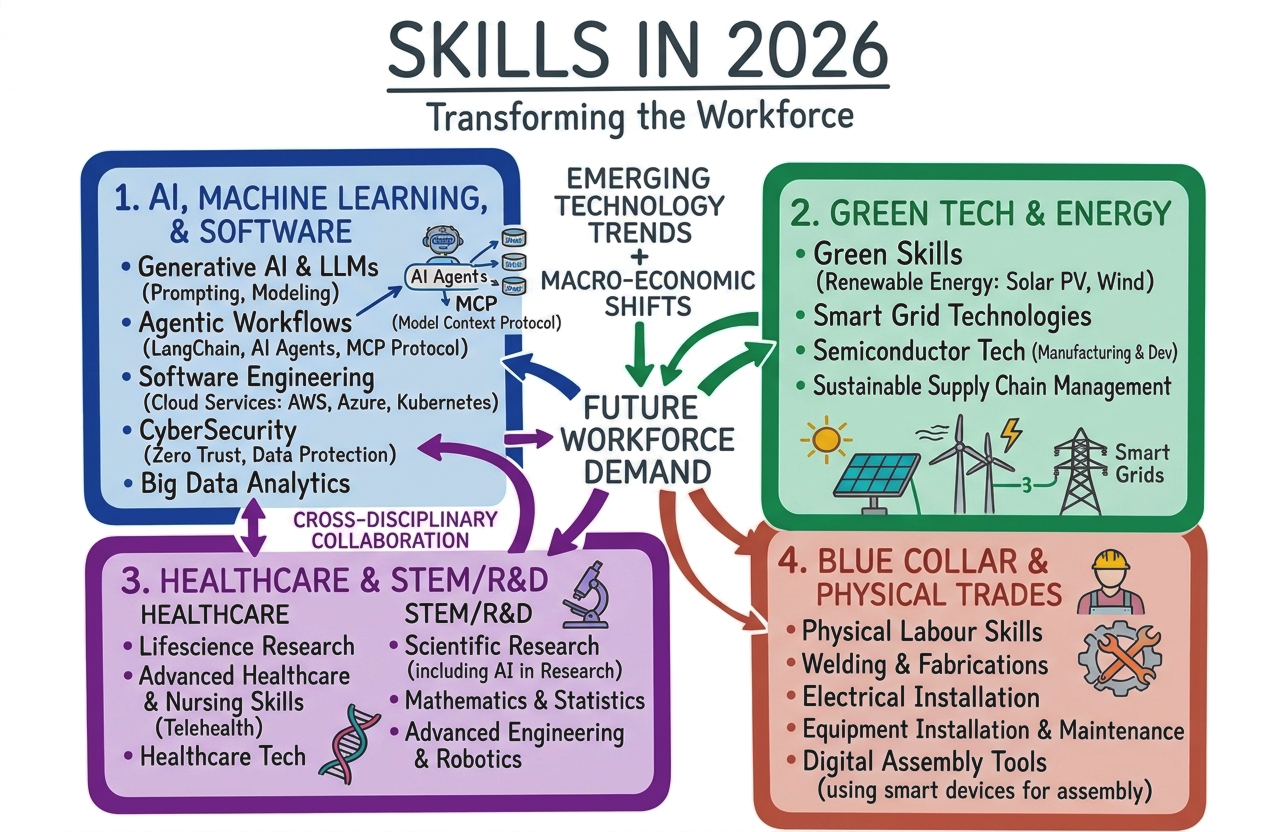
The skill sets for the future and workforce challenges
Now, in-demand jobs are either at the lower end of skills requirements and complexity or at the higher end. There are either jobs involving vocational education in construction and installation areas or high-skill roles in research requiring a scientific background.
Obviously, the way organisations acquire talent is affected in the long term. But this is hardly a novelty because we always have to deal with changes. As always, we’ll need encouragement and support to keep up with new technology and develop new skills. In recent years, skills changes have become a complex issue alongside social problems like health crises, an ageing population, and climate change. AGI advancements have placed a lot of pressure on the global job market.
However, a lack of proper working conditions, low salary levels and employers’ inability to attract skilled talent are also causing skills shortages. Ironically enough, the current global trend in hiring due to the current job demands is actually the skills-based approach. Skills-based hiring is an approach that values people who have and practice the ability to learn and adapt. Organisations that develop an agile workforce will be capable of meeting future challenges.
New skill sets and skills-based hiring trend
Skills-based hiring is not a trendy approach, but a strong building block strategy for organisational growth. Performance hiring will always consider specific skills as a minimum employment requirement. Due to the high demand for particular skills, talent acquisition has changed focus and prioritised skills over education or credentials. Eurobarometer shows that SMEs face a skills shortage of 20% for R&D jobs, 18% for IT, 12% for marketing and 8% for HR experts.
However, a real solution to tech innovation disruptions has been systematic adaptation through learning and new skills development. According to Gallup, employees are 56% more likely to strongly agree that they are motivated to learn new skills when learning a new skill is recognised in a workplace.
In times of crisis or radical changes, we are always coming back to the building blocks of things. In the job market, the skills frameworks are the basis of any occupation. On a larger scale, currently, some organisations are creating skills-based models to align themselves with the skills-based approach and generate competitive skills talent pools.
The main objective of skills-based models is to help people develop new skill sets, perform better or prepare for a career change. Learning new skills and facilitating different career paths is based on the skills gaps identified at the organisational level. Skills models are intended to help build detailed skill sets and proficiency frameworks. A clear and solid set of skills will contribute to making strategic decisions about talent development.
Skills for the Future
The soft skills we acquire throughout our lives and in different workplaces demonstrate how we carry out our responsibilities and are related to personality traits, personal attributes, and attitudes towards life. But beyond the tech or hard skills that we need for every kind of occupation or career path we pursue, there is a set of skills that is unique to each and every one of us. This set of skills comes from the life experiences and circumstances we gather throughout our lives.
In the context of AI evolution, a strong set of soft skills might be an advantage and contribute to a positive mindset for facing work challenges. Different sets of skills, less or more complex, can be periodically improved. Transferring lifelong skills into work environments can increase career success.
Soft skills and hard skills
Advanced skills in math, health, life sciences, machine learning, and AI research are in-demand tech skills. Creativity, curiosity, communication, and emotions are skills and personal traits that make us who we are and will matter more in the future.
Because of artificial intelligence’s evolution, our world is changing faster than expected. In almost every field of work, repetitive tasks might be automated, and jobs are at risk. A Dell survey showed that 65% of organisations are already forecasting results for their AI generative initiatives.
Deloitte’s predictions say that by 2030, soft skill-intensive occupations will account for two-thirds of all jobs by 2030. Soft skills like communication and teamwork, which contribute to business revenue and growth, will be the real skills of the future.
According to the EU Council, the EU needs between 6.2 and 7 million AI-related workers. The EU estimates rising demand for STEM professionals due to the green transition, defence, biotech, space and the evolution of AI.
Estimations say that by 2030, besides AI literacy skills and semiconductor technologies, shortages will impact green skills for domains such as solar PV, renewable energy and smart grids. The same will happen with healthcare and nursing skills and technical and manual occupations like welding and electrical installation and maintenance.
So, jobs as we know them now will cease to exist, and AI, robotics, and automation will convert them into a huge database of soft and hard skills. Along with benefits like less manual work, improved quality of life, and more free time, AI is also a huge challenge for humanity.
Soft skills transformation
Most industries are already being affected by the development and adoption of AI. The integration of agent-based workflows and the need for AI supervision are contributing to a reduction in specialised jobs. Within an organisation that integrates AI tools, roles are becoming more generalist in nature and cover a wider range of processes or functions, which places greater value on soft skills.
In these strange times, we should remember that certain personal attributes and soft skills, such as problem-solving, empathy, and active listening, are evergreen. Learning new skills is like taking a plunge into the unknown universe. But it’s also a chance to surpass our limits or at least to do our best.
A good example of soft skills transformation over time is remote collaboration. Remote collaboration is now a hiring requirement in job ads. It also involves other skills like communicating with team colleagues and sharing virtual workspace, information and work progress. Remote work has made it possible to build teams across the globe and work in sync, no matter the time and space.
However, as incredible non-artificial-intelligence human beings living on this planet, we might unlock potential and new possibilities and shape the world in surprisingly positive ways. Embracing continuous learning and flexibility will help people navigate uncertainty more effectively, balancing AI and economic disruption with resilience. Hopefully, we’ll become wiser in using our creativity and native intelligence to find solutions, rather than choosing a road toward a dystopian future.
References
- OECD Skills Outlook 2025, Building the Skills of the 21st Century for All
- Workplace Intelligence Forecast 2025
- CEDEFOP: Elementary occupations: skills opportunities and challenges
- Deloitte: Soft skills for business success
- Official Journal of the European Union, Council Recommendation of 9 March 2026 on human capital in the European Union
- Pluralsight: Top Tech Predictions for 2024 By Julie Heming
- McKinsey Global Institute: Jobs lost, jobs gained: What the future of work will mean for jobs, skills, and wages
- Global Skills Report 2026 and our new AI-Human Skills Synergy Index—the first of its kind in the world by Coursera & Udemy
FAQ
Technical skills and soft skills are equally important for building a career. However, soft skills are becoming more valuable in the job market because automation can replace repetitive tasks, but skills like creativity, active listening, communication, critical thinking and empathy remain difficult to automate.
The most important future skill sets include AI literacy, critical thinking, creativity, adaptability, communication skills, and empathy. These skills will help professionals stay relevant as technology and job roles continue to evolve and manage the complexity of automated work environments.
In-demand jobs are either at the lower end of skills requirements and complexity or at the higher end. A high-end new skill set would be learning about AI Agents, Machine Learning, LangChain, Kubernetes, and Cloud services (AWS, Azure). Also, jobs involving vocational education in construction and installations or high-skill roles in research requiring a scientific background.
Simona Cimpoieru