

Last update
Simona Cimpoieru

Active listening is an intentional, effortful way of understanding what and how people communicate, a core communication skill and one of the most powerful tools for building meaningful connections and conversations. Scientists have discovered measurable effects in the brain and important influences in professional environments of active listening.
In today’s fast-paced working environments, active listening is less common and is becoming a more valuable skill. Genuine listening requires some of the most important resources we possess: our time, attention and understanding. Science proves that active listening physically rewires the brain and contributes to building authentic, measurable trust. In this article, we’ll explore what active listening is, how it influences us and our environment and neuroscience discoveries on how the brain works while listening.
Today, neuroscience and psychology are conducting research that confirms that we need to be heard, understood, and valued so we can thrive. The ability to truly listen is the first step in creating lasting relationships and a form of attention and appreciation we can offer to people.
Why active listening matters: a powerful skill for personal Growth
Genuine active listening is, in these ever-changing times, like a lost art of humanity. People have always reached out to good listeners in times of distress, seeking comfort and understanding. Instinctively, we seek good friends, attentive colleagues or family to share problems or ask for advice. Active listening is not only a skill, but it’s also an educational tool and a powerful communication technique.
In antiquity, the art of listening was a pedagogical method for self-improvement and achieving wisdom. Two of the most famous philosophers considered listening to have an important role in society. Aristotle used listening for persuasion; the listeners were active participants rather than passive receivers, capable of making decisions on the validity of a speaker’s argument. Pythagoras’ earliest followers were known as “those who listen.” As beginners, they had to take a five-year vow of silence to embrace it and turn their attention inward — learning to observe themselves with discipline and self-awareness.
Meaningful conversations and connections
Ancient philosophers’ views are subject to psychology and modern neuroscience to be proven scientifically. The term “active listening” was coined by Carl Rogers in 1957. Scientists describe active listening as a social skill, a communication style, a tool that directly changes how the brain works, or even a way of life.
If active listening is a social skill, it’s more of a learned skill that needs continuous practice rather than an innate ability. However, most authors recognise that active listening involves three stages: understanding the verbal message, interpreting nonverbal cues and providing feedback that demonstrates comprehension of the message.
Active listening requires communication techniques like paraphrasing what you hear, observing nonverbal cues, and providing thoughtful feedback and demands our full attention and genuine engagement. Overall, active listening is a complex ability requiring simultaneous actions such as processing language, suppressing the urge to interrupt, formulating feedback with empathy, but most of all, it requires our full attention and engagement, helping us be more attuned to others.
The neuroscience of active listening neuroscience – brain rewiring through listening
Advancements in brain imaging technology can explain why listening matters at the neurological level. An insightful research stating that listening is neurologically rewarding was conducted by using functional magnetic resonance imaging (fMRI) technology. Its findings revealed that when someone truly listens to us, our brains react the same way they do when we receive a reward.
In other words, feeling heard is not just emotionally satisfying — it’s neurologically rewarding. Study participants who felt genuinely listened to by someone displaying active listening showed increased activation of a brain region which is a key component of the brain’s reward system. This brain region, called the ventral striatum, responds to monetary rewards, delicious food, and other pleasurable experiences.
Reframing past experiences while listening
Also, this study shows that when participants are actively listening, a specific brain region (the right anterior insula) increases activation. It seems that this part of the brain helps us process and shift our emotions — turning negative feelings into more positive ones. Consequently, active listening doesn’t merely feel good in the moment—it actually helps us positively reframe our past experiences.
When people listen to you describing a painful memory, their attention makes your brain process that memory more positively. So, sharing a stressful situation with a good listener helps your brain reframe it, making you feel more positive about that experience. More surprising is that listening is rewarding even if this happens when the speaker is simply perceiving someone as actively listening. So, when speakers sense that people are actively listening, this triggers positive emotional reappraisal.
Brain synchronisation: how listener and speaker resonate
Studies demonstrate that during active listening, the prefrontal cortex (responsible for decision-making), the limbic system (emotions), and mirror neurons are active and support empathy and emotional resonance. Active listening is more than a simple transmission of messages or information from one person to another. Most of the time, we tend to see it as attentive listening or listening without interruptions by our interlocutors. In reality, active listening is a dynamic process of creating and sharing our social environment.
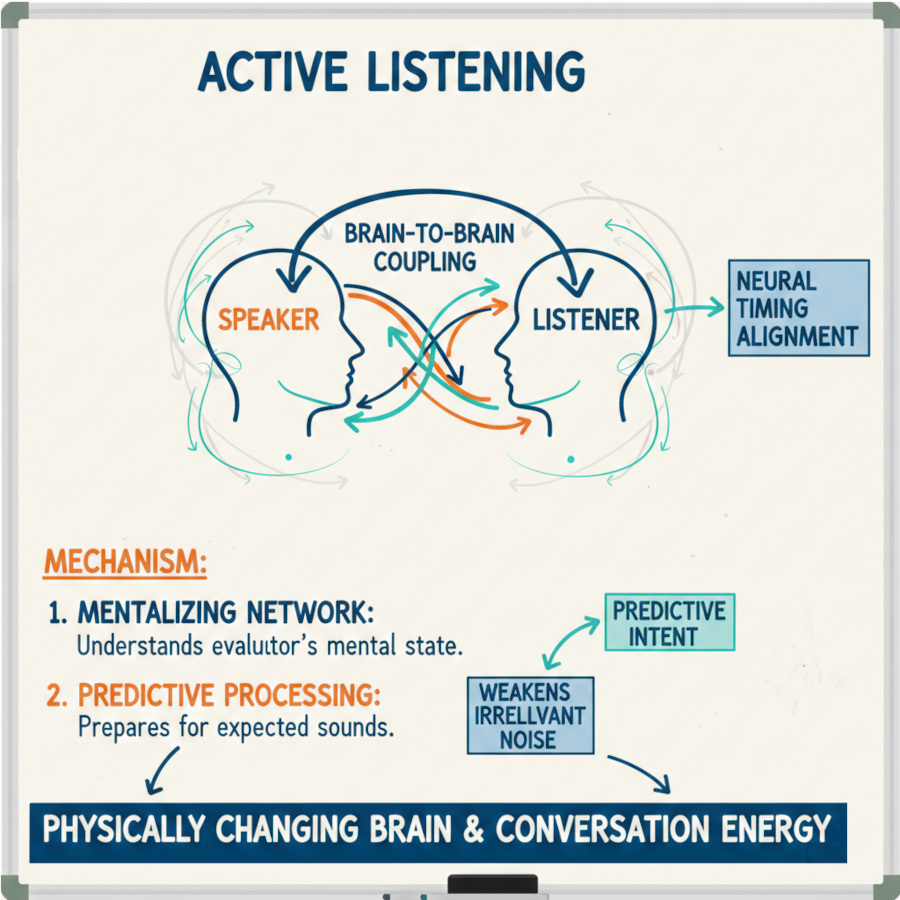
The actual mechanism generating the real active listening is quite complex. Recent studies revealed that the active listening brain network is physically changing the brain and the energy of the conversation. Researchers detected synchronised activities of brain regions responsible for meaning, emotion and context.
Research reveals that meaningful conversation looks like a synchronised wireless network. During the study, listeners’ brains actually mirrored speakers’ neural activity and their brain waves literally synchronised. Most importantly, researchers discovered that the strength of this brain-to-brain coupling predicted comprehension: the stronger the neural synchronisation, the better the listener understood the speaker.
Predicting words: we anticipate what others will say
Active listening is the foundation of efficient communication and is far more than attentive hearing. Your brain doesn’t passively receive words; it actively anticipates them. This predictive mechanism allows you to sync with speakers, understand emotional nuances, and respond with genuine empathy.
A different study about how the brain processes sound when we focus identifies a predictive processing mechanism that allows the brain to prepare for and predict expected sounds while temporarily weakening connections to irrelevant background noise.
This study shows that the auditory cortex is a predictive system that constantly prepares for what it expects to hear next. This predictive listening allows the listeners to align their neural timing more precisely with the speaker’s rhythm. In essence, the study reveals that our brain uses these internal ticks to ensure it’s ready for the next word before it even reaches our ears.
The brain reward system activation
The brain understands an evaluator’s mental state through a specialised mentalising network and a phenomenon known as brain-to-brain coupling, in which the listener’s neural activity synchronises with that of the speaker. This process involves not just reacting to the evaluator but actively predicting their intent and mirroring their neurological patterns.
Active listening is a complex skill playing an important role in our emotional well-being and quality of life. Indeed, findings indicate that authentic listening is a neurological catalyst that activates the brain’s reward system, releases oxytocin to build trust, and triggers mirror neurons to synchronise behaviour.
By developing this active listening, we strengthen our capability to manage emotions, solve problems, and build human connections. In essence, predictive listening transforms communication from an information exchange into a synchronised conversation that enhances both emotional well-being and professional relationships.
Key points: the neuroscience of active listening
Neuroscience discoveries explain how active listening influences people and reveal its force, proving that it can physically align two people and change their perspectives.
- Authentic listening activates the brain’s reward system. When someone truly listens to us and shows real interest, it feels deeply satisfying. In fact, the brain responds to active listening in the same way it responds to receiving money or praise, seeing the experience as a reward. Simply put, perceiving someone actively listening makes your brain feel good.
- Active listening might positively transform your memories. Active listening can actually change how we remember the past. Neuroscience studies show that memories are not fixed. We constantly re-evaluate past experiences based on how we feel in the present. When someone listens to us, it activates a brain region that helps us reframe those memories in a positive light. This means that when we share a painful experience, our brain softens that memory, making us feel better about it.
- Good listeners’ brains are in Sync. When two people have a meaningful conversation, their brains actually sync up. The speaker’s and listener’s brain activity begins to mirror each other — a phenomenon known as brain-to-brain coupling. This synchronisation becomes even stronger when the brain picks up on the context behind the words being spoken.
- While listening, our brains anticipate the future. In certain areas of the brain, the listener’s neural activity actually precedes the speaker’s. Rather than passively waiting for the words to be spoken, the listener’s brain actively predicts them. The brain uses an internal “clock” to anticipate the timing and content of the next sounds. This enables it to filter out background noise and focus on relevant information. It resembles a fine-tuned predictive mechanism with the role of assuring the efficiency of the communication process.
- We automatically try to guess the other interlocutor’s intent. When people discuss, they interpret what their interlocutors are doing and why. Studies indicate that the brain activates specialised regions whenever people are evaluated while listening. The brain automatically activates this network to figure out people’s true intent. If people are listening to you empathically, this mentalising network will interpret their behaviour as acceptance and a rewarding conversation.
References:
- The Emerging Frontier of Interpersonal Communication and Neuroscience: Scanning the Social Synapse: https://academic.oup.com/anncom/articleabstract/44/4/368/7906636?redirectedFrom=fulltext&login=false
- Kawamichi H, Yoshihara K, Sasaki AT, Sugawara SK, Tanabe HC, Shinohara R, Sugisawa Y, Tokutake K, Mochizuki Y, Anme T, Sadato N. Perceiving active listening activates the reward system and improves the impression of relevant experiences. Soc Neurosci. 2015;10(1):16-26. doi: 10.1080/17470919.2014.954732. Epub 2014 Sep 4. PMID: 25188354; PMCID: PMC4270393. https://www.researchgate.net/publication/265343777_Perceiving_active_listening_activates_the_reward_system_and_improves_the_impression_of_relevant_experiences
- Hasson U, Ghazanfar AA, Galantucci B, Garrod S, Keysers C. Brain-to-brain coupling: a mechanism for creating and sharing a social world. Trends Cogn Sci. 2012 Feb;16(2):114-21. doi: 10.1016/j.tics.2011.12.007. Epub 2012 Jan 3. PMID: 22221820; PMCID: PMC3269540. https://pmc.ncbi.nlm.nih.gov/articles/PMC3269540/
- Li Z, Hong B, Nolte G, Engel AK, Zhang D. Speaker-listener neural coupling correlates with semantic and acoustic features of naturalistic speech. Soc Cogn Affect Neurosci. 2024 Aug 2;19(1):nsae051. doi: 10.1093/scan/nsae051. PMID: 39012092; PMCID: PMC11296674. https://pmc.ncbi.nlm.nih.gov/articles/PMC11296674/