

The traditional office and on-site working arrangements are becoming optional as remote and hybrid work models reshape professional landscapes worldwide. This fundamental shift isn’t temporary—it represents a permanent transformation in how we balance career ambitions with personal autonomy. Recent data shows that in Europe, the hybrid model dominates and globally, work-from-home levels have stabilised. This article explores remote and hybrid work models, their advantages, implications in the professional working settings, possible risks and countries with available remote job opportunities.
Remote Work Statistics and Trends for 2026
In 2025 and 2026, European workplace trends are characterised by high hybrid work adoption, a resilient digital economy, and a competitive market for digital nomads. The Stanford Global Survey of Working Arrangements reveals that work-from-home (WFH) arrangements are most common in North America, the UK, and Australia, and least common in Asia.
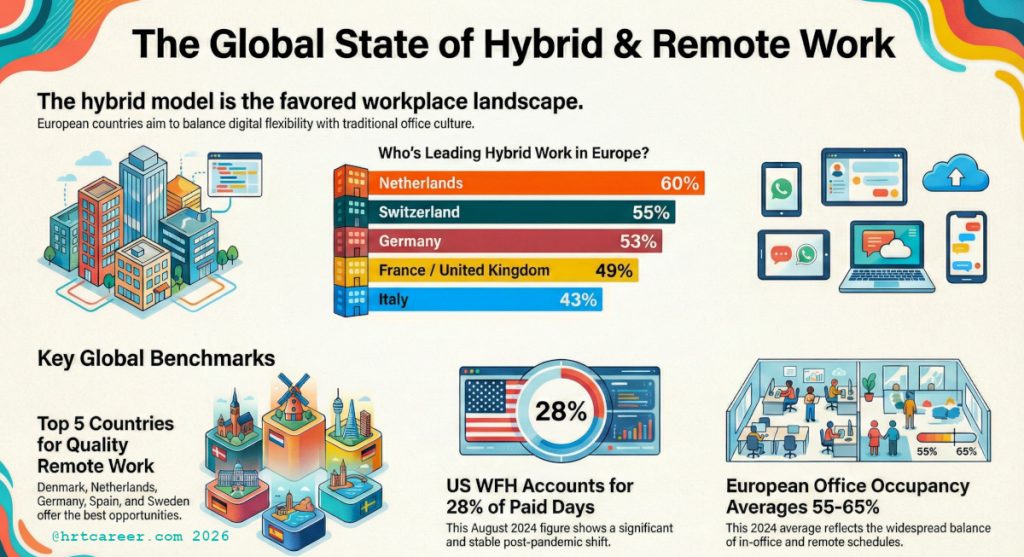
European countries aim to balance digital flexibility with the traditional office-based culture, but the two models are not yet synchronised. In 2024, the office occupancy in Europe averaged between 55% and 65%. According to the Global Remote Work Index, which evaluates the potential of countries to qualify as remote work destinations, Denmark, the Netherlands, Germany, Spain, and Sweden have the highest score for quality remote jobs. Then come Spain, Sweden, Portugal and Estonia.
Since 2022, the remote work levels have stabilised. A WFH research shows that in the US, the pandemic increased WFH, equivalent to almost 40 Years of pre-pandemic growth. In August 2024, about 28% of paid days in the US were WFH days. Hybrid work is most prevalent in the Netherlands (60%), followed by Switzerland (55%) and Germany (53%). Other major markets report lower hybrid rates, including France (49%), the United Kingdom (49%), and Italy (43%). The current workplace landscape is in favour of the hybrid model.
Flexible work models in the future
Different 2025 statistics conclude that flexible work arrangements can enhance macroeconomic efficiency without damaging overall performance. The reason behind this trend is the alignment of jobs with personal lifestyles and people’s strengths. Working from home allowed people to focus on their work at home rather than commuting every day. The result was a stable performance due to organising their working time to master specific tasks more effectively while combining with family activities and leisure time.
A McKinsey report of study shows that the most common reasons for a career change are: greater pay, better career development opportunities and a flexible working arrangement. People decide to change jobs because of their need for flexibility in the working relationship. The main reason for preferring to work from home was to save commuting time. This factor has made 38% of hybrid workers willing to live farther from their physical office locations.
Consequently, people prefer remote or hybrid work for different reasons, and the most relevant one is the freedom to choose their agenda from the comfort of their homes. This freedom of choice gives us a sense of independence and privacy. This might be related to working away from colleagues or without direct supervision.
However, in 2025, 39% of employees’ top reason for not changing roles is job security, which represents a significant shift in workforce priorities. It’s a fragile balance of home comfort, daily ups and downs of work productivity, inspiration and house chores. Remote work has been converted into a common practice in the working space to offer more flexibility for harmonising our professional and private lives and indirectly improving work performance.
From a temporary solution to a flexible work culture
Remote working it’s a real change in how we envisage the future of our professional lives. We are shifting away from the classical working form to flexible work agreements like work from home, contractors and freelancers.
There is a generally positive outlook on remote working globally. The remote working trend has significant long-term social and economic implications. Some are related to new types of working spaces, new virtual tools and a mindset transition towards a new life and work balance.
Remote working options continue to develop alongside technological advancements. Cloud tech and AI can play a major role in the long run. Many expect remote work opportunities, so businesses must embrace workplace innovation. Unfortunately, by comparison with the pandemic period, fully remote jobs were in decline in 2022 in both the US and Europe.
How remote work improves work-life balance
Whether we work remotely or not, we permanently seek to balance our daily work and private life. Two of the most important motivation factors for choosing remote work jobs are work flexibility and personal autonomy. So, flexibility and autonomy are natural tendencies for everyone wanting to reach that life and work balance.
Also, for most people to be content with what they do, personal autonomy to make decisions is a must. Remote professionals have higher levels of job satisfaction due to better work-life balance, flexibility and an optimistic mindset due to more autonomy. Employers are challenged to meet the expectations of a workforce inclined towards flexible work arrangements.
Highly developed countries have a greater number of remote roles available. Companies are adapting to a new work model by investing in technology, adjusting their policies, and helping employees effectively. The implications of this flexible work model shift extend beyond modelling a new workforce. Unfortunately, remote jobs are not available for everyone. However, due to the nature of work, there are a lot of jobs that can be done only on-site.
More working hours and virtual office space
There are also negative aspects of remote or hybrid roles. A remote job may involve more working hours and less clear boundaries between work and private life. Another problem of remote working is the burnout risk due to unclear disconnecting employers’ regulations. Remote companies have decreased, but flexible working needs haven’t.
Remote work outside the traditional office space and working schedule has changed the very nature of work. It seems that we are on a difficult journey to seek out new ways of balancing private and professional spaces. The time spent remote working at home or in virtual spaces shapes our professional and personal lives.
Though flexible working arrangements are dominating job preferences, there are also challenges faced by remote workers. Remote work temporarily dissolves the countries’ borders and allows companies worldwide to tap into a global talent pool. Because of the possibility of cultivating personal well-being, remote jobs are in-demand.
The hiring legal requirements are changing to accommodate remote work conditions. In Europe, employers can take advantage of this opportunity to harness in-demand know-how and technical skills. Information Technology (IT) dominates the world of remote working because of the tech tools that allow it, especially cloud technologies. Cloud tech is helping with the necessary infrastructure, working towards a virtual workplace concept.
Risks that come with remote and hybrid jobs
Along with the advantages came the risk of working at home or from anywhere across the world. The first immediate consequence is that remote jobs can make us lose real working connections. Social isolation is a risk that might become a reality as we immerse ourselves in remote working, daily tasks and lose track of time and space around us.
There are industries with working conditions that are not able to provide remote working opportunities. So, remote opportunities generate another employment inequity that can lead to frustration. Even if the high demand exists, there are not enough remote job offers. In Europe, depending on the cultural heritage, working styles became a combination of the remote and classic work frameworks.
On the whole, isolation and cutting off from immediate reality can be a real threat to society’s overall cohesion and development. With new technological possibilities like AI, it’s easier to get disconnected from core values and practicality.
From remote work to the hybrid model
The hybrid working model came as a compromise to meet our needs for freedom about when and where to work. In order to balance professional and private life, employers are mixing the traditional and remote working models. This compromise can also be a tactic to improve the employer’s benefits policies. Though legal requirements for remote jobs are lacking and ambiguous, hybrid work is now a negotiation variable in the hiring process.
Currently, hybrid models are becoming more popular, and most companies are adopting a hybrid approach instead of fully remote work positions. Hybrid work means that employees work partially remotely and partially in the office. It is a compromise that still provides flexibility and opportunities for in-person collaboration.
Overall, remote working can be a strategic hiring option for companies that aim to attract talent and remain competitive. The flexible approach of remote work has the potential to reshape the job landscape. It’s not a temporary adaptation to a health crisis, but a real and positive mindset shift in how we approach work. In essence, employees are no longer choosing jobs based on proximity to their homes, but rather on the flexibility their careers can provide.
References:
- Global Remote Work Index: https://nordlayer.com/global-remote-work-index/#countries-score-table
- Barrero, Jose Maria, Nicholas Bloom, and Steven J. Davis, 2021. “Why working from home will stick,” National Bureau of Economic Research Working Paper 28731. www.wfhresearch.com
- Institute for Economic Policy Research (SIEPR) Working from Home in 2025: Five Key Facts: https://siepr.stanford.edu/publications/essay/working-home-2025-five-key-facts