

- 1. What is the metaverse?
-
2.
The Metaverse – challenges, boundaries and data privacy
- 3. Transcend boundaries and get comfortable with AR
- 4. The digital environment and enhanced learning experiences
- 5. Avatars and virtual social interactions
- 6. How can the metaverse influence human psychology?
- 8. The challenge of data privacy and the safety of users
- 9. Personal safety boundaries in the metaverse
“All the world is made of faith, and trust, and pixie dust.”
J.M. Barrie, Peter Pan
What is the metaverse?
The term metaverse was coined by N. Stephenson in 1992 and has been changing continuously. It started as a promise of a safe virtual world, a new kind of internet mix between reality and a digital environment. The initial science fiction vision resembles a large-scale multiplayer online game. Nowadays, there are different interpretations about its implementation, and there is no agreement on metaverse definitions.
Today’s trends are shifting away from the original fictional idea to creating a virtual universe model with social and economic implications. The intention behind the metaverse is to develop different asymmetric virtual worlds. These digital environments are three-dimensional virtual spaces where people, represented by avatars, can interact, work and share experiences in real time.
However, the development of the metaverse faces technical and socio-economic challenges, such as infrastructure costs and privacy concerns about data collection. Technologically, the metaverse relies on a blend of Extended Reality (XR)—which includes Virtual, Augmented, and Mixed Reality—alongside Generative AI, the Internet of Things (IoT), and blockchain for digital ownership.
The metaverse universe is a digital immersive imitation of the real world; it offers socialising, gaming, shopping, and working. This mix of the physical world with virtual images allows people to control how they are perceived. This is because metaverse users can customise their virtual appearance and digital space to be comfortable and free to enjoy themselves.
The Metaverse – challenges, boundaries and data privacy
The entire ecosystem, products, and services will be created through code and technological infrastructure. The complexity of this endeavour and the technical resources involved in mimicking our real world might seem like a utopia. However, big tech companies are working on it, and other organisations aim to get involved. They promise to create marketplaces that enhance our experiences with their services and products using immersive technologies.
The metaverse became a reality for several industries, which use it to optimise their operations, safety, and training. Technologies like digital twins, AR, and AI-driven simulations are already in place in sectors such as manufacturing, urban planning, and energy. The healthcare and nursing sector already has tangible results. For example, NYU College of Dentistry has trained students using VR in anaesthesia procedures, allowing for repetitive practice without the real risks or costs of materials.
Metaverse seems more like a valuable ideal to be chased and a good investment in the future. Different organisations use this concept and present their products, services, games, stories, and visions. All of these real items are to be transposed into a digital virtual environment. Similarly, they should follow the physical laws and regulations of our real world and offer us an enhanced immersive experience.
Transcend boundaries and get comfortable with AR
In the near future, we will need to familiarise ourselves with the tools and technologies used by multiverses. The question is, what skills will we need to interact properly with the multiverses? In order to adapt to such a dynamic and interactive environment, we need an open mind and a lifelong learning mindset.
So, anyone who enjoys video games and immerses themselves in game fantasies, virtual lands and simulated environments will easily adapt. Video gamers, 3D or 4D enthusiasts, and e-sports players already have the skills to manage within the multiverse. Not only will they do better with web3 tech, but new career paths are already available to them.
Even if most of us are not familiar or comfortable with using AR glasses and haptic feedback devices, the number of mobile augmented reality (AR) apps is gradually increasing. According to Statista, the number of mobile augmented reality active user devices worldwide will be 1.7 billion in 2024.
The digital environment and enhanced learning experiences
However, building fictional virtual worlds requires a diverse and complex set of skills. Cross-industry technical and soft skills, like design, gaming, social interaction, animation, and blockchain, are needed to develop this new interactive digital world. Envisioning how different components combine to create a harmonious digital environment with a solid infrastructure is a real endeavour.
Probably the most useful application of the metaverse will be in our education. Learning and training will benefit from creating virtual classrooms, complex training simulations, and immersive learning experiences. We will probably be able to transcend physical boundaries and make learning more interactive and attractive.
Language learning, history contexts, and science laboratory projects will be easier to customise and understand. Using blended learning might enhance the learning experience and facilitate a detailed context for better retention and learning.
Multiverses revolve around the idea of opening new doorways to a second world within the digital realm. In this multilayer interlinked virtual environment, we are to experience a second life. We can interact with people through avatars, which allow us to communicate, connect and engage in different activities.
Furthermore, the avatar we choose holds a virtual identity tied to us, the real person. It’s like a close representation of our personality traits, gender, and ethnicity. We can think of them as an artificial extension of ourselves, and use them for work, entertainment, digital art, or creative activities.
Just like real social interactions, the avatars’ social interactions need to follow rules and moral principles and avoid offensive, aggressive, or ill-intended behaviours. However, we should not forget that behind an avatar is a real person who can choose certain personality traits and hide others, as it happens with social media profiles.
Metaverse, like all technologies, has important effects on people’s minds and behaviours. After all, human nature is unpredictable, and how people will behave within the metaverse is up to their free will. What side of their personality will prevail in a virtual dispute depends on their circumstances and personal choices.
How can the metaverse influence human psychology?
The metaverse influences the human psyche through complex, immersive, sensory, and emotional experiences displayed in the digital environment. Several studies show that VR applications and gamification therapies can reduce anxiety, depression and improve sleep quality when led and designed by psychotherapists and medical specialists. Gamified therapies and immersive environments are used for exposure therapy in phobias and social anxiety.
However, the beneficial effect depends on an individual’s circumstances and the context in which it is applied. For example, VR training can simulate high-stress conditions, allowing users to refine their skills in a safe, controlled medium. As users in a metaverse, people can assume an identity, possess desired skills and traits, and create a persona and environments suitable to their aims.
The sense of control over virtual images and digital environments has therapeutic benefits, but it can also make people fall into addiction traps. Researchers indicate that the metaverse’s impact on human psychology depends on the user’s social context, age, location, and mental health. Though it avoids the costs and risks of developing complex skills, it demands specific technical knowledge and awareness of mental issues and cybersecurity risks.
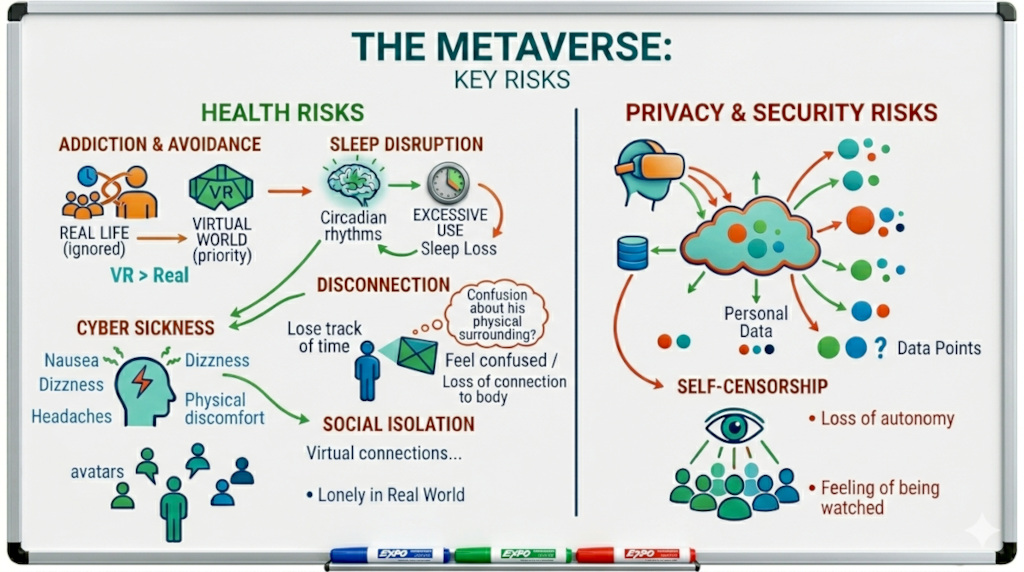
While the metaverse can offer benefits, it also presents significant risks to people’s health, privacy, and social status. Studies on the metaverse’s effects on health1 revealed several possible risks.
Here are some of the metaverse’s possible risks for health and privacy:
- Addiction behaviours – virtual space and interaction become more important than real life
- Avoidance –an escape from daily stress, real-life confrontations and challenges
- Sleep disruption – anexcessive use can disrupt users’ circadian rhythms
- Cyber sickness – a physical discomfort such as motion sickness, nausea, dizziness, and headaches
- Disconnection from reality –deep immersion can lead users to lose track of time or to feel confused and not connect with their physical bodies
- Social isolation – virtual interactions with other users lack emotional depth, users are connected online, but in the real world are lonely, and they lack social skills
- Privacy and security risks – platforms collect biometric and personal data, making cyberbullying and harassment, data theft and deep fakes possible
- Self-censorship – users may act under the assumption of being watched, causing loss of autonomy, literally their sense of independence
The challenge of data privacy and the safety of users
Metaverse futuristic worlds, reality, and interconnectivity are blending the rules of our earthly existence with digital technology. As with everything newly created by technology and involving social interactions, the metaverse has long-term consequences for users’ privacy.
Consequently, personal privacy and user safety are raising another dilemma. To educate and protect ourselves, we need to stay informed about at least two of the regulations created to protect us in the EU: the General Data Protection Regulation (GDPR) and the Digital Markets Act (DMA). The Digital Markets Act (DMA) aims to apply procedural rights and obligations to digital platforms and qualify them as gatekeepers. The GDPR handles the consent for personal data processing.
However, we need to agree on different sets of rules for each platform to benefit from the functionalities across digital platforms. Metaverse providers need to verify users’ accounts to track their activities and avoid bots and fake accounts. Using technical cookies that are part of data collection and processing could render mandatory consent useless. Large amounts of personal data can be processed without us having to control it.
Personal safety boundaries in the metaverse
Applying rules to avatars that represent the user’s real identity is a complex issue. The owner of the avatar has to take responsibility for its behaviour. Still, it’s difficult to imagine the punishment of a virtual identity by real laws and not consider this a distant dystopia. But no matter how many rules public authorities implement, the metaverse providers will have control over the data generated by users.
Nevertheless, with the coming of multiverses, we might get a virtual version of the rule of law. Ultimately, legislators will pass laws to prevent negative attitudes or abusive behaviour toward each other, as they always do. An example that illustrates the adaptation of rules is Meta’s 4-foot rule related to personal safety boundaries.
Humanity’s history is a good teacher, and it shows us that laws will change to make room for innovations, especially if financial opportunities are involved. Let’s stay informed and make educated decisions about how to use the metaverse.
References:
- Wang Y, Duan B, Chen X, Song Y, Liu X. The application of metaverse in mental health.
Front Public Health. 2025 Apr 10;13:1463494. doi: 10.3389/fpubh.2025.1463494. PMID: 40276352; PMCID: PMC12018439. 2. Paquin V, Ferrari M, Sekhon H, Rej S. Time to Think “Meta”: A Critical Viewpoint on the Risks and Benefits of Virtual Worlds for Mental Health. JMIR Serious Games. 2023 Feb 7;11:e43388. doi: 10.2196/43388. PMID: 36661284; PMCID: PMC9944144. ↩︎