

The empathy concept originates in a theory called Einfühlung promoted by German philosopher T. Lipps. Over the years, it was translated into English as “Empathy” by E. Titchener and acquired different interpretations. Currently, there is no consensus on the definition of empathy, as there is an interdisciplinary debate about empathy as a phenomenon, trait, or ability.
Empathy has been integrated into different models, such as the five Emotional Intelligence Quotient (EQ) elements. Mostly, empathy definitions regard empathy as a concept with an emotional dimension as well as a rational or cognitive one. The emotional dimension refers to the state of sharing feelings, or, commonly said, being in the other person’s shoes and understanding the person’s feelings, which relates to the cognitive dimension of empathy.
There are a lot of interpretations of empathy, and its implications extend to cultural contexts, genetics and neuroscience. For a long time, this concept was underestimated and negatively associated with overwhelming emotions and subjectivity. But, in the past years, scientists struggled to study and bring more light to the empathy phenomenon. Psychologists and neuroscientists succeed in reinstating empathy as a valued psychological and social dimension of our humanity and communities.
Emotion Understanding and Recognition of Facial Expressions
Whether we like it or not, we are all connected through our communities and personal interests. Empathy can also be considered a developmental trait in our community context. It can also enable us to relate to, help, and understand the people around us. However, knowing about other people’s feelings might not be enough to help. To get the full picture of someone else’s emotional state, we need more details about the situation and their personal circumstances.
Yet, considering Theodor Lipps’s concept of Einfühlung, its initial meaning was related to feelings. Originally, his theory was intended to explain how people experience inanimate objects and understand other people’s mental states. He was trying to create a framework for understanding our capacity to assign feelings to objects or people.
These days, we assign emotions and feelings not only to novels’ and movies’ characters, and pets, but also to cartoons, robots, and avatars. Most of all, we invest feelings in personal objects that might be reminders of precious memories. Indeed, the conceptual beginning of empathy was Th. Lipps endeavours to explain how we animate things or objects around us. Maybe we should try to periodically keep the initial signification of empathy, as this trait is complex and important for our society’s welfare.
The neuroscience of empathy
Several studies emphasise that empathy has an important role to play in revitalising and strengthening our relationships both at the individual and community levels. Research conducted mainly in the healthcare industry confirms that empathy is a complex component of human behaviour and more than an innate trait or a soft skill.
Studies also reveal that by imitating or simply observing emotional facial expressions, similar neuronal networks are activated in our brains. Empathy determines people to help and understand each other by stimulating the same motor and sensory areas in the observers’ brains as the person they are observing.
We can unconsciously mimic the actions and facial expressions of others through a mirroring brain mechanism. So, empathy can be triggered by simply observing people’s faces and expressing emotions. Overall, it looks like our empathising capability has a critical role in understanding behaviours and subtle nuances of others’ life experiences.
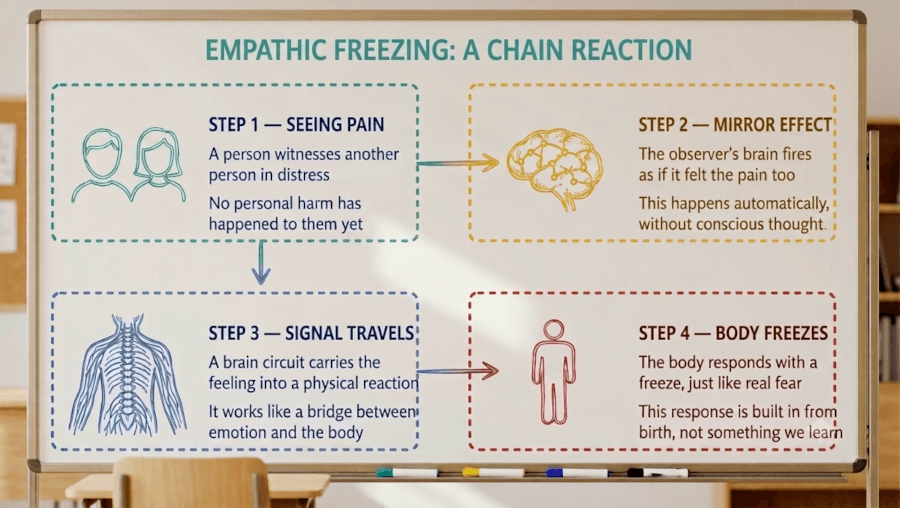
Researchers at the Institute for Basic Science have identified the neural pathways responsible for affective empathy by observing how mice reacted to the pain of others. This study revealed that a fear-based reaction of simply witnessing someone else’s pain or distress causes your own body to freeze. Scientists say this is wired into our brain and is a built-in mirroring response. It’s almost as if you were the one experiencing it and freezing up while watching someone else get hurt or upset, even though nothing happened to you.
A specific brain pathway acts like a bridge, turning the experience of witnessing someone’s distress into empathetic freezing. These findings prove that empathic responses are innate and are not something we learn. In practice, this isn’t just a feeling, and it can lead to a real physical reaction.
Learning how to be more empathetic
We can understand emotional reactions by reflecting on our experiences and then correctly identifying them in other people’s reactions. It could be useful to learn emotional indicators or types of expressions and even probable behaviours for a better understanding of emotions.
So, the first step in learning about empathy is that we need to acknowledge that it begins with the recognition of our own feelings. To perceive people’s emotions, we need to be aware of our emotional states, which is obviously a lifetime endeavour, and we are all continuously learning in this area.
Indeed, empathy relates to feelings and how we process them in relation to other people. But some of us are more skilled at this ability than others, although this might depend on our social background and circumstances. Still, this doesn’t mean we can’t train this ability or even sharpen it. To become more empathic, we need to understand and accept our own feelings; otherwise, we won’t even recognise them, and even less understand them.
Emotion recognition and genuine concern for the people we are interacting with are the main components of empathy. Learning programs can teach empathy or the perspectives of being empathetic. Maintaining positivity and good social relationships are some of them. Empathy learning focuses on understanding emotions, identifying with other persons, or practising different perspective-taking.
Tips on how to be more empathetic
- Assessing levels of empathy through questionnaires. To get a glimpse of how empathetic we are, use tools like questionnaires to evaluate how well we react to others’ emotions. Two of these free tools are the Interpersonal Reactivity Index (IRI) and the Empathy Quotient (EQ).
- Learning and understanding how emotions manifest and their facial cues. This might raise our empathy level and awareness of people’s emotions. A useful, free tool for learning and understanding emotions is the Atlas of Emotions, developed by P. Ekman and supported by the Dalai Lama.
- Reading fantasy books and watching movies from the fantasy genre. The reason is that by experiencing fiction, readers escape from their daily routine.
A study demonstrates that reading fantasy makes us more empathetic. It seems that this type of experience enhances inspiration and our capacity to experiment with other interpersonal skills. That would be an easy and pleasant way to practice and become more empathic. Therefore, returning to the origin of empathy, Einfühlung literally means “in-feeling”.
Empathy can greatly contribute to developing more compassionate relationships. Though it is a subjective capability because it involves our feelings, it enhances our interconnectivity. More than other abilities require us to consider the feelings of others and possibly act upon them if necessary.
Practising empathy is like being in a constant improvement loop to understand ourselves and the people around us. Therefore, through empathising, we are transposed to the land of emotions and subjectivity. Still, we’ll share similar perspectives as the people next to us while appreciating our humanity.