

- 1. Learning and Talent Development Trends 2025: AI and Skills-Based Systems
- 2. Personalise learning paths & embedded experiences
- 3. Learning and Talent Development Defined: Concepts and Strategic HR
- 4. What is the difference between Learning and Development (L&D) and Talent Development (TD)?
- 5. How do organisations implement L&D programmes?
- 6. L&TD Strategies: Inclusive vs. Exclusive Talent Approaches
- 7. L&TD for Employees: Career Paths and Competitive Advantage
- 8. Learning & TD Strategies: Key Components and Best Practices
- 11. New Skills Are Critical for Market Success
Learning and Talent Development (L&TD) is a strategic Human Resources function that includes two complementary approaches. The first approach, Learning and Development (L&D), focuses on building workforce capabilities across all employees through training, coaching, and skill-building. The second, Talent Development (TD) targets high-potential employees for advancement through succession planning, leadership development, and career progression. Together, L&TD helps organisations bridge skill gaps, enhance performance, and maintain competitive advantage in rapidly changing markets driven by AI integration and technological innovation.
Learning and Talent Development Trends 2025: AI and Skills-Based Systems
Today’s workplaces face significant changes due to advances in AI technology. Most organisations are planning to integrate AI tools into their services, products and business processes. According to a 2025 LinkedIn Workplace Learning Report, GAI adoption shows 15% increase, 88% of organisations are concerned about employee retention, so they provide learning opportunities as a retention strategy.
Before 2020, learning and development meant traditional classroom training and learning completion metrics. After 2020 and the pandemic, learning and talent development integrated virtual learning spaces into the remote and hybrid working models.
After 2023, the learning model transformed into“skills-based ecosystems” with the help of AI and workflow integration. From personalised learning videos and skills-based platforms, continuous learning habits, learning development has switched towards the need for AI skills and bridging skills gaps to foster organisational agility.
Personalise learning paths & embedded experiences
According to McKinsey research, in the future, L&TD will use personalised learning paths and predictive analytics. These are employee-tailored journeys to acquire new skills and knowledge through experiences embedded into their workflows. Companies are adopting AI to personalise learning paths, facilitate internal mobility, and fill the AI skill gaps. Because AI automation implementation tends to reduce the workforce, acquiring AI skills has become a priority for most companies.
Predictive analytics and behaviour tracking across functions will shape talent development decisions
In this context, Learning and Talent Development (L&TD) can help organisations and people to keep up with changes and develop new skills to remain competitive. However, the focus will be on human-centred skills such as communication, leadership and emotional intelligence.
Because AI is taking over repetitive tasks, L&D professionals are seen as strategists on soft skills and learning experiences. The new L&TD trend favours hyper-personalised and autonomous learning paths. Also, organisations aim to implement strategic upskilling, incorporate AI agents and performance support into learning and talent development platforms.
Learning and Talent Development Defined: Concepts and Strategic HR
Learning and talent development, like many evolving management concepts, has no widely accepted definition. At the organisational level, Talent Development (TD) is part of Talent Management (TM), which is part of Human Resources Management (HRM).
In his Handbook of HRM, Michael Armstrong defines Talent Management as follows: Talent management is the process of ensuring that talented people are attracted, retained, motivated and developed in line with the needs of the organisation.
This concept refers to talent attraction, retention and development in an organisational context. So, talent management covers the acquisition, development, and retention of talent. In essence, TD focuses on the people development and upskilling of current talent in an organisation.
TD helps existing talent evolve and acquire competencies in line with the organisational strategy. As people are prepared, they will be ready to take on more complex roles with greater responsibilities and accept leadership roles.
Talent Development is strategically oriented towards high-potential talent. It involves identifying key positions that contribute to the organisation’s competitive advantage. The aim is to strengthen organisational capability through processes such as succession planning, leadership development, and top talent retention.
What is the difference between Learning and Development (L&D) and Talent Development (TD)?
According to the Chartered Institute of Personnel and Development (CIPD), a learning and development strategy sets out the workforce capabilities, skills and competencies and is a key requirement for a business strategy implementation.
Learning and Development (L&D) connects with the Human Resource Development (HRD) concept. It implies the integration of all learning and development operations, practices and processes into a strategic direction of HRD. In Human Resource Management (HRM), Learning and Development (L&D), and Talent Development have distinct definitions, though they complement each other to some extent, they overlap. TD is more future-oriented and builds organisational growth, leadership competencies, succession plans and career paths.
Learning and Development concentrates on enhancing employees’ skills and capabilities as well as improving group and individual effectiveness. Furthermore, L&D is a strategic HRM function helping employees perform in their jobs and develop for future opportunities. Continuous learning, lifelong learning, and learning organisations are also concepts and practices related to Learning and Development (L&D).
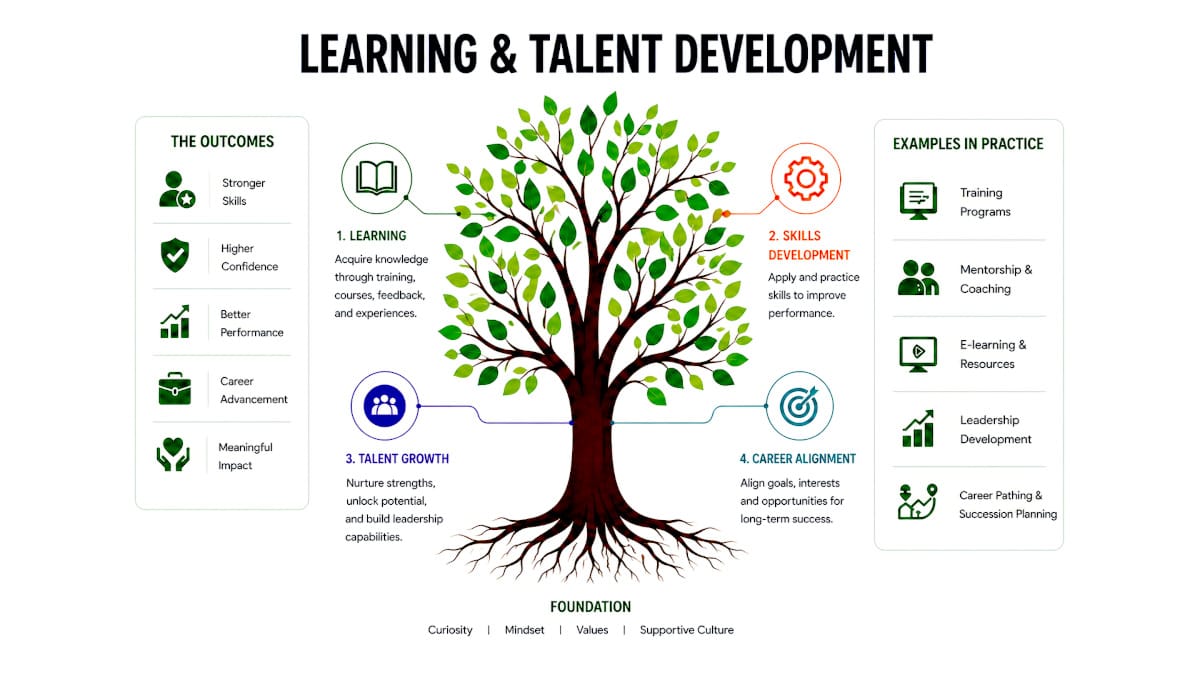
How do organisations implement L&D programmes?
Different views on whether talent is an innate or developable trait create various TM organisational practices. Opinions about the implementation of the talent concept are sometimes conflicting. However, HR professionals ‘ practice ranges from pleading for the rarity of talent to the inclusive assumption that everyone has a talent.
Overall, L&D is an intentional organisational effort to provide employees with opportunities to obtain new knowledge and adapt to new working conditions. L&D professionals enrol people in training programmes and design learning frameworks for:
- Courses,
- Coaching or mentoring,
- Professional qualifications,
- Certifications,
- Apprenticeships and
- Upskilling or reskilling.
Both L&D and L&TD aim to implement a people development strategy. TD is seen as a subset of L&D and a more selective, targeted approach to talent. However, there are other variables to consider when deciding on a talent development strategy, such as the industry type and the size of the organisation.
L&TD Strategies: Inclusive vs. Exclusive Talent Approaches
L&D’s objective is to build continuous operational skills and support performance and people’s adaptability. Also, it’s both a short-term and long-term goal and the real building block of any organisation. TD aims to identify high-potential talent and drive competitive advantage and strategic leadership.
A research article in the International Journal of Human Resource Management on TM practices revealed that HR managers working in smaller organisations are more likely to implement an inclusive talent approach. This type of talent approach corresponds to a broad L&D capability building. TD focuses on cultivating employees’ high potential, while L&D applies to the entire company workforce.
Authors like M. Thunnissen warn about the risks of exclusive approaches and the benefits of balancing inclusivity with targeted talent strategies. In essence, these TM functions focus, purpose, and methods are different. However, they are also complementary and adaptable to organisational sustainability and competitiveness.
L&TD for Employees: Career Paths and Competitive Advantage
In our professional lives, we gain experience and knowledge and improve our performance. Our world is continually changing, and so are the aptitudes and qualifications necessary to perform different jobs. TD can play a key role in strategic positioning in a constantly changing environment.
Legal, technological and political changes have immediate effects on organisations and institutions. AI, health crises, and social conflicts are waves of change that have the power to move people and companies worldwide.
Organisations face changes and need to prove resilience to help people thrive. A consistent answer to these changes makes the difference between success and failure. This is where learning and development can be of real help.
The integration of new knowledge and technology is vital for keeping up with the social and economic evolutions. On an individual level, it can also help us progress in our career paths and improve our professional opportunities. Also, for a business, having learning and talent development programmes in place can attract competent and motivated candidates. For employees, the long-term advantages gained are related to the:
- Development of skills and work experience,
- Higher productivity and work performance, and
- A clear development path with defined goals,
- Training or qualifications courses for a future career.
Learning and developing new skills not only helps us stay competitive but can also attract new, talented people to our side. Few jobs, if any, are protected from the constant turmoil and harsh competitive reality. We need to learn new things and acquire skills all the time so we can surpass future challenges.
Learning & TD Strategies: Key Components and Best Practices
L&TD can play an important strategic organisational role. Through this process, organisations can adapt to market needs and align with social trends and market demands. New capabilities and know-how are acquired by implementing learning and talent development strategies.
A successful talent strategy begins with a clear vision of employees’ development needs. Organisational growth targets should be aligned with the overall business objectives. The first thing to consider when designing a talent development strategy is that it should involve the people it is designed for. Employees need a general image of the competencies they will need for future projects. Also, their involvement is important for stronger motivation and commitment in case of future problems.
An important part of a talent development strategy is to determine the level of employees’ capabilities. This is how we determine current work frame capabilities and identify potential for improvement. For this phase, we can design questionnaires, use assessments or self-assessments and previous performance appraisals.
Talent Acquisition Strategy: Attract and Retain Top Performers
Attracting the brightest talent to join a company is a continuous process and a long-term strategy. The talent acquisition function’s role is also to inspire people and to make hiring more efficient. Adapting recruitment tactics to new technological trends can enable organisational agility. ATS (Application Tracking System), social media, compliance, learning platforms, and events are tools that convince top talent to join good companies.
Talent acquisition strategy implementation starts by truly understanding the talent organisations already have. When they hire, they’re investing in people, but you also build on their internal potential. The target is to bring added value and generate a long-term relationship.
The role of recruitment in talent acquisition strategy is tactical. Recruitment should be aligned with a talent acquisition strategy as part of the overall talent strategy. The areas with the greatest skills gaps are those in need of long-term development.
Transforming Technological changes into opportunities
Once we have a general picture of the skills we already possess and identify the gaps, we can design a learning and talent development plan. The talent development journey should be aligned with the business strategy.
L&TD develops people by combining both individual needs and organisational requirements. After implementation of learning plans, training, coaching or mentoring activities, the next step is keeping track of how things progress. Work performance can indicate if the learning and development interventions were successful or if other initiatives are needed.
For almost all types of organisations, integrating learning and development as a strategic direction into business strategy brings additional resources and support for general objectives. At the same time, it constantly transforms new technological breakthroughs and socio-economic evolutions into learning opportunities.
New Skills Are Critical for Market Success
So, new skills and tech become valuable work experience that brings an edge to the market. Also, part of learning and talent development success is the organisational synergy that comes from both individual and team efforts.
Skillsets for jobs are changing, and most organisations are facing a talent shortage. One of the reasons talent disruption appears is the lack of qualified talent to use new technologies. When social and technical changes arise, so does the talent shortage.
Therefore, having clear learning and talent development planning and budgeting helps organisations to keep up with changes and stay on a path of positive evolution. L&TD’s goal is to improve both individual and group performance by increasing knowledge and developing a specific set of skills.
Talent Development Paths: Building Organisational Agility
The talent development path is transposed in an organisation as having clear development paths for all roles. This means designing transparent career opportunities for professional growth by working together to establish attainable goals and create customised plans that outline the training, learning resources, and new work experiences needed to take the next development steps.
By choosing a talent development path, talent agility can be achieved by identifying potential for further development. Organisational capability to respond to changes through learning new skills is decisive. When creating a long-term talent strategy, the most important thing is to design explicit roles, responsibilities, and career development paths that integrate a continuous learning mindset.
The learning and development process plays a major role in creating a flexible and agile talent workforce. Hiring high-potential talent can be a winning strategy. Due to recent tech and social changes, recruiters and talent partners have become advocates of remote work and reskilling. Digital and technical market demand is making learning and development a solution to fill skills gaps and new roles.
Learning and Talent Development contributions to organisational success
Developing people’s potential creates a competitive advantage for companies, can improve operational efficiency and contribute to employee retention. For example, implementing long-term leadership learning and talent development programmes solves succession planning and enables business growth.
Nurturing leadership skills for people with the will and potential to become leaders is one way that learning and development contribute to organisational success. The reality is that adaptation to social and political complexities is a continuous challenge for everyone.
Thriving in such a changing environment makes continuous learning and talent development a necessity. A firmly set and well-executed learning and talent development strategy is needed to strengthen organisational capabilities and achieve success.
Both employees’ and organisations’ learning agility is essential for navigating this increasingly shifting market. Investments in talent development are actually a constant pursuit of strategic organisational objectives.
By implementing talent development plans, companies gain stronger market positioning through a more skilled workforce, and employees achieve skill mastery, confidence and a better work-life balance. Continuous learning is a beneficial mindset not only at a personal level, but also to the entire organisation. It’s a powerful edge that can strengthen organisational capability and drive synergy and wellbeing.
References:
- Handbook of HRM by Michael Armstrong
- International Journal of Academic Research in Business and Social Sciences: Talent Development Practices: A Revisit as an Imperative for Talent Retention, Bathmavathy Dalayga, Shathees Baskaran, Nomahaza Mahadi https://hrmars.com/ijarbss/article/view/8578/Talent-Development-Practices-A-Revisit-as-an-Imperative-for-Talent-Retention
- The International Journal of Human Resource Management, HR managers’ talent philosophies: prevalence and relationships with perceived talent management practices, Meyers, Talent management: for what, how and how well? An empirical exploration of Talent Management in practice.M. C., van Woerkom, M., Paauwe, J., & Dries, N. (2020). HR managers’ talent philosophies: prevalence and relationships with perceived talent management practices. The International Journal of Human Resource Management, 31(4), 562–588.
- Thunnissen, Marian. (2015). Talent management: for what, how and how well? An empirical exploration of Talent Management in practice. Employee Relations. 38. 10.1108/ER-08-2015-0159.