


Last update:
Author:
Soft skills are interpersonal and behavioural abilities that shape how people work and interact. Unlike hard skills, they apply across industries and career stages. Their importance is increasingly recognised as we navigate the challenges of technological evolution in our changing world. This article explores the most important soft skills for career growth and how they are balancing and leveraging hard skills.
Some of the most important soft skills for career growth are communication, creativity, lifelong learning, empathy, and problem-solving. These soft skills are valued across industries because they complement and strengthen technical expertise and remain relevant throughout a person’s entire lifetime. Soft skills can gradually enhance our capabilities to adapt to new realities and facilitate personal growth.
The importance of soft skills
Soft skills can be both interpersonal skills and qualities learned through experience. As recent studies show, hard and soft skills often overlap. The two types of skills are classified separately, and they also depend on each other. Soft skills are versatile competencies applicable across industries and may include communication, teamwork, collaboration, creativity, problem-solving, and critical thinking.
Most educational researchers agree that soft skills are foundational competencies. They support the ability to learn advanced technical skills throughout our entire lives. For example, a 17-year study shows that teaching 8-year-old children basic socio-emotional skills like self-control, patience, and problem-solving has a real impact on their future.
The children were 23% more likely to complete high school and 26% more likely to enrol in university. This study indicates that developing these skills early creates a “behavioural anchor”. Also, they reduce ADHD symptoms, help children focus and develop their thinking to solve more complex problems.
The 5 most important soft skills for career development
Learning soft skills is not as easy as we may think because, unlike hard skills, their acquisition period and integration are different. These skills have broad applicability in our lives and provide long-term benefits. Areas such as leadership, social networking, and decision-making gradually increase their importance with experience over a lifetime. The emergence of AI tools and their influence on workplaces is a wake-up call to value basic lifelong skills that make us unique.
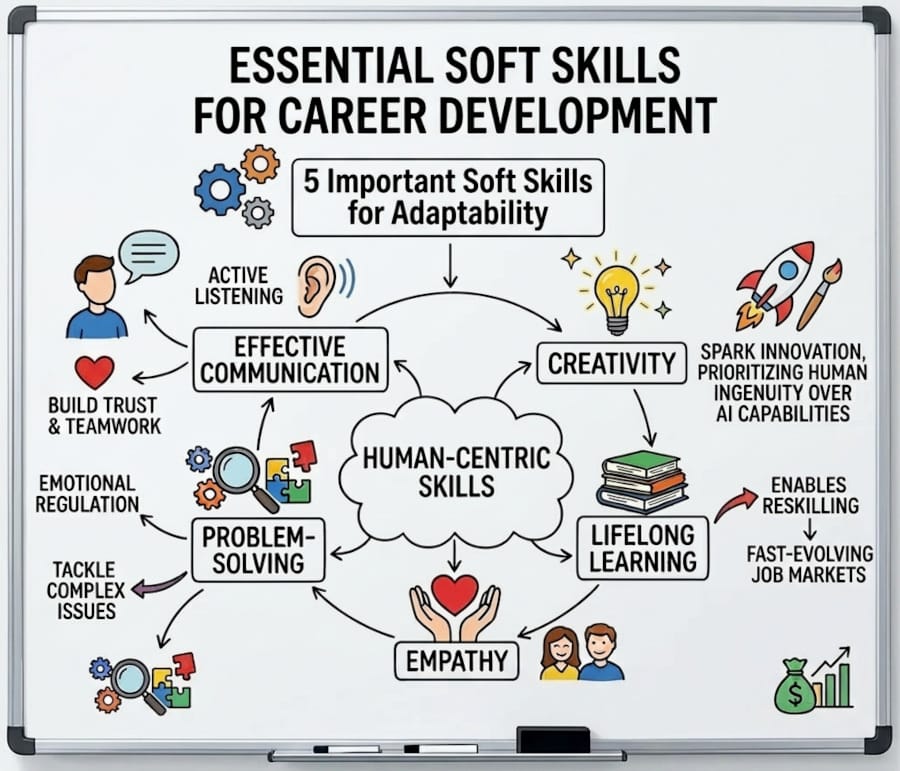
1. Effective communication
The most important core skill of all is communication, as it significantly impacts career development and professional life. For industries like tourism, healthcare and marketing, communication skills are vital. Communication is a complex skill with deep socio-psychological implications in our lives and a base skill on which other skills are developed, structured and built.
Achieving efficiency in communication is strongly linked to being an active listener. Practising active listening can make the difference between being a poor or effective communicator and can empower people to interact, understand, and respond to each other appropriately.
Neuroscience shows that active listening enhances “neural synchrony” between people, meaning their brain activity actually begins to align. By developing active listening skills, people strengthen relationships, trust and help create a collaborative working environment.
Both communication and active listening are essential soft skills because they are the foundation for all other professional and technical skills. How people communicate shapes their work interactions, their level of involvement, and their ability to adapt to new environments.
2. Creativity
Creativity is the most precious skill you can possess in these changeable and inconsistent times. Creative people have been initiators of innovations and inventions across humanity’s history. Nowadays, because of AI tools, creativity has become a key skill that sets people apart from machine intelligence.
Coming up with new ideas, solutions and answers has always been a valuable skill in any industry or working context. Viewing problems as opportunities rather than obstacles is where problem-solving and creativity go together. Obviously, people who think outside the box have more opportunities in their careers.
According to a WEF Future of Jobs report, creativity is among the most important skills companies will prioritise for reskilling through 2027. Most leaders are aware that ingenious solutions will future-proof their businesses and positively impact communities. Having colleagues with creative visions motivates and inspires teams to engage and achieve more.
3. Lifelong learning as a Soft Skill
In the context of AI growth, lifelong learning has become a critical and valuable skill, with the potential to yield future-favourable professional outcomes. Lifelong learning as a skill can be related to learning how to learn. The benefits of lifelong learning and development are more obvious in agile organisations or those that adopt continuous learning.
Certain skills have shorter lifespans than others, and overall, the average tech skill has a lifespan of 2 years or less. However, the constant acquisition of knowledge and skills throughout our lives is also a good and strategic solution for employers to fulfil their changing hiring needs.
Embracing learning as a core lifelong skill can lead to a more accomplished professional life and an easier development path. Lifelong learning can be a valuable mindset for both our personal and professional growth. It can be a useful strategic mindset that answers one of our primary needs for adaptation in changing environments.
Constantly learning new things and acquiring new expertise and knowledge can lead to valuable opportunities and gratifying life experiences. The constant willingness to develop new skills and acquire up-to-date information will help us respond to the different turns and shifts in markets.
4. Empathy
Empathy is one of the most complex human behaviours, and it can be both an innate trait and a soft skill. It is about understanding and sharing another person’s feelings from their perspective. Developing empathic behaviours facilitates a better understanding of people’s inner motivations for their actions.
Studies reveal that imitating or simply observing emotional facial expressions activates similar neuronal networks in our brains. Empathy can foster cooperation by understanding people’s points of view. Practising empathy throughout our entire lives can facilitate our growth.
Being an empathetic person depends on exposure to experiences that determine people to help and understand each other. So, the more we practice it, the more neural circuits associated with empathetic behaviours are strengthened over time. People can develop cognitive empathy by combining role-playing with perspective-taking exercises to reinforce and learn to be empathic.
5. Problem-Solving
Because of generative AI, some workloads can be replaced. A McKinsey report shows that companies focus more on retraining employees and less on hiring to meet skill needs. Additionally, 30% of the workload could be automated by 2030. But in Europe, demand for social and emotional skills could increase by 11%.
Problem-solving skills are essential when dealing with complex issues, both at the workplace and in private life. Daily challenges require solutions in this constantly unpredictable, evolving world. Problem-solving involves breaking down complex issues to identify root causes and find appropriate solutions. It builds on creative thinking and empathy skills to uncover new ways to address challenges.
A problem-solving skills study of emergency medical services shows that people who use emotions and feelings when solving problems are better at problem-solving. Therefore, when training people in emotional regulation skills, their problem-solving skills improve. Solving difficult situations under pressure is a strength and a suitable competency to take on new responsibilities.
Overall, problem-solving is essential for addressing professional responsibilities and finding effective solutions. It builds on critical thinking and is important for professional success. So, a good problem-solving track record throughout a career path can demonstrate leadership potential to employers.
Soft skills can balance hard skills
A 2025 study published in Nature Human Behaviour indicates that technical expertise, such as coding and engineering, relies on human-centred abilities. The researchers argue that technical skills are nested within human-focused soft skills—such as communication, critical thinking, and adaptability.
Soft skills leverage hard skills by making them visible and useful to others, and they balance them by providing the flexibility and human connection required to apply technical tools. The same research indicates that nearly 80% of the higher pay of technical experts is actually driven by their soft skills, such as leadership and teamwork.
In the long term, effective communication, lifelong learning, creativity, empathy and problem-solving are skills that we can rely on to pursue different career pathways. Learning and developing these soft skills is a way to address technological change and social disruption. They also facilitate information and knowledge sharing, which is a key driver of innovation.
How can soft skills complement hard skills in an AI-driven society?
Regardless of the impact of technology adoption on workforce environments and employment, soft skills can make a difference in the future of work. Even if there is a higher demand for technical jobs, organisational cultures need a balance.
Soft skills like efficient communication, creativity, and empathy are leveraging technical skills. Organisations need to foster a positive culture so people can interact more effectively, be more creative and thrive. Critical thinking and problem-solving serve as the primary skills for resolving complex problems and supporting decision-making.
Also, as technical skills or repetitive tasks become obsolete, adaptability and lifelong learning allow us to reskill or change career paths. However, without strong core soft skills, most people get stuck in low-pay jobs that can be automated and offer fewer growth opportunities.
While soft skills are difficult to measure, their impact cannot be underestimated, even in AI-driven workplaces. Constantly improving these skills can have long-term benefits for our well-being and help us to stay connected. We rely on our traits and qualities in both our personal lives and professional interactions. So, cultivating soft skills is a win-win that strengthens hard skills, supports career growth, and enhances well-being.
Ready to put your soft skills into practice?
Knowing the most important soft skills is one thing — knowing your own strengths is another. The free Career Insight Tool gives you personalised insight into your natural abilities, so you know exactly where to focus.
FAQ
The most important soft skills for career development are effective communication, creativity, lifelong learning, empathy, and problem-solving. These skills apply across industries and career stages and they remain valuable even as technical skills become outdated.
Hard skills are specific, teachable technical abilities such as coding, data analysis, or accounting. Soft skills are interpersonal and behavioural competencies like communication, empathy, and adaptability that shape how people work and interact. Research increasingly shows that soft and hard skills overlap and depend on each other.
Yes. While some soft skills have innate components, most can be developed through practice and experience. Skills like empathy can be strengthened through perspective-taking exercises, and communication can improve significantly through active listening practice.
As AI automates repetitive and technical tasks, the skills that set people apart are increasingly human-centred. Creativity, empathy, and active listening can’t be replicated; they are important distinguishing factors in AI-driven workplaces.