

Last update
Simona Cimpoieru

The benefits of learning a second language are often underestimated because learning a foreign language is included in almost every formal schooling system. We usually value speaking a second language because of knowledge exposure and better career opportunities. However, the entire process of acquiring a second language is a long-term cultural sharing experience and a tool for self-improvement. In this article, we’ll discuss the benefits of learning a second language, such as enhanced cognitive abilities, improved sociability and empathy, career growth, cultural awareness, and increased memory.
Why is learning a second language important?
Learning a second language improves flexibility, mental processing and strengthens memory connections. In the context of AI evolution, this can be an asset because bilinguals have task-switching flexibility and an enhanced capacity to manage information. Mastering a second language provides a good understanding of language structure, syntax, and semantics. Also, cultural differences awareness might prove valuable when working with natural language processing (NLP) models.
Research on learning a second language suggests that not only does knowing a second language enhance cognitive processes, but it also determines the improvement of task-switching abilities due to language switching. Scientists conclude that further study of the frequency of language switching might reveal any task-switching benefits.
A 2026 research article shows how reading ahead of audio helps improve speakers’ vocabulary. The authors used eye-tracking technology and discovered that looking at words before they are heard makes mental processing faster and improves word recognition. When a reader sees a word before hearing it, it creates a small gap between seeing the word and hearing it. This pause is helpful because the audio arrives exactly when your brain is already focused on the word’s sound.
The study suggests that this audiovisual asynchrony creates a psychological alignment that helps learners connect words’ written forms with their sounds and meanings effectively. Linking the letters to sounds frees up mental resources that would otherwise be spent just trying to decode the word, making word recognition faster. In conclusion, reading ahead speeds up the familiarity of a word; it helps establish a clear memory representation, strengthening memory connections.
What are the benefits of learning a second language?
Learning a foreign language implies constant practice and exposure to a language-learning environment. These benefits include maintaining mind sharpness, better communication and decision-making skills, and cultural awareness. We can safely say that speaking a second language is a valuable acquisition for self-improvement and personal development. Though it is a time-consuming and long-term learning endeavour, it has many advantages.
Advantages of learning a new language
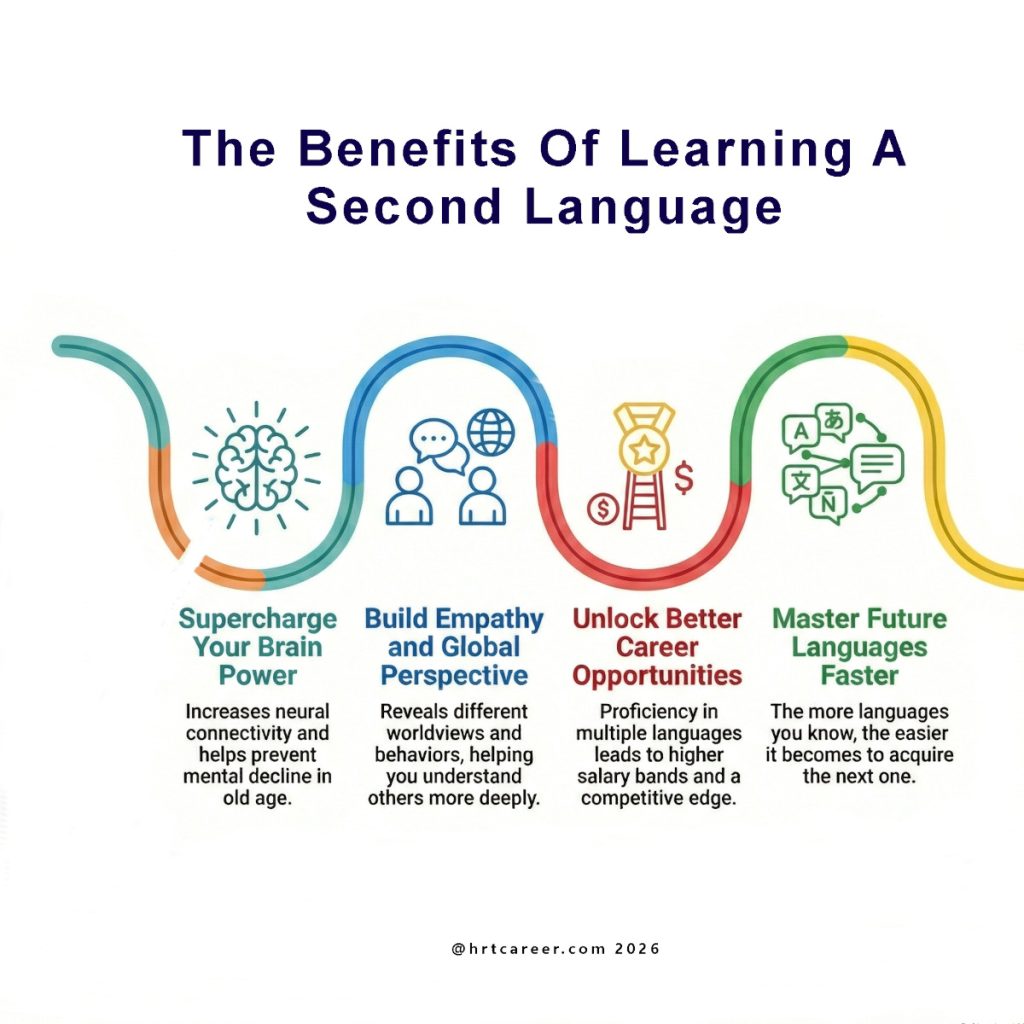
- The more languages you know, the easier it is to acquire a new language. Studies reveal that the more languages you speak, the easier it is to learn other languages. From a neuroscience point of view, it seems that brain neural connections are more activated when we use a foreign language rather than our native language.
- Increases brain activity and mental sharpness. Research confirms that speaking a foreign language significantly boots brain connectivity. By reorganizing neural pathways, the brain learns to process and manage information more effectively. As a result, multilingual speakers think faster and process complex details quicker. Beyond performance, studies show that picking up a second language protects against cognitive decline in old age. To boost cognitive agility and preserve long-term brain health, medical specialists can recommend learning a second language.
- It improves social connectivity and empathy. There is also an area of improvement related to empathy. Knowing a second language can reveal different world perspectives, habits and behavioural patterns regardless of age. Speaking a second language is an ongoing learning process because it involves social interaction. Bilingual or multilingual environments favour understanding perspective-taking and contribute to empathy development.
- It’s a rewarding cultural experience. The process of acquiring a second language is a long-term cultural sharing experience. Mastering a new language can give a clearer view of other nations’ customs and a deeper understanding of people. A different language means different habits, books, travelling or studying in various countries. Knowing a foreign language is like an open door to a different view of life. Apart from better memory and new nuances of words, a language is a chance to recognise cultural differences between countries and also a tool to remove communication barriers and make friends more easily.
- More career opportunities and better pay. Whether bilingual or multilingual, the more languages you speak, the better the salary opportunities. Speaking more than one language opens career opportunities locally and internationally. Most companies prefer hiring bilingual or multilingual candidates to gain a competitive edge in the market.
Language acquisition is a valuable asset
Learning a new language is an asset for self-improvement. Speaking a foreign language can boost our memory and creativity and reveal other world perspectives. Handling more than one language from early childhood can influence both the structure and function of the brain. We can consider second language acquisition a valuable asset, a health benefit and a rewarding cultural experience.
Understanding a second language stimulates the brain and keeps it active, which may prevent or delay neurodegenerative diseases. Overall, research shows that bilingual people have better associative memory. This means we can remember things by associating them with something we already know or have experienced, better than people who speak one language.
Knowing a second language can increase the brain’s grey matter density and white matter integrity, thus improving our thinking and understanding. The earlier we start learning another language, the better. Studies prove that even if you learn a new language at a later age, you’ll still be able to improve your brain’s performance.
Among the benefits of bilingualism are improvements in selective attention, task switching, and decision-making processes. Consequently, we can consider maintaining our reasoning skills, increasing mental agility and postponing brain ageing as one of the advantages of mastering a second language. Recent studies on older adults who learnt a new language showed better attention and focus, demonstrating the brain’s capability to adapt and strengthen. So, learning a foreign language in old age could help avoid mental decline.
When Should Children Start Learning A Second Language?
Every language has its particularities, and it comes with cultural differences. To master a foreign language, a child needs exposure to a learning environment, acquiring new vocabulary and a lot of practice. The decision to start learning a second language would depend on access to a suitable learning community, motivation and willingness to learn.
Studies show that it is easier for children to acquire a second language if they start at an early age. Kids should start learning a new language at the same time as they learn their first language, but no later than 10 years old. Children’s learning is grounded in their surrounding environment through social interactions and listening to people. While learning a foreign language, they acquire other skills like communication and even understanding their own culture by comparison.
Early exposure helps reach native level
Early exposure to a second language increases their chances of speaking a native level of the second language. According to research, the main reason children should start learning another language really early is brain shaping through exposure to sounds, phrases, intonation and word structures. It seems that between infancy and adolescence, the brain is naturally shaped to learn languages. Children learn fast, and they are able to immerse themselves in a complex learning context
But not everybody agrees with early exposure to a second language for kids. Some studies recommend starting to learn a foreign language at 7 years or even 11 years due to the brain’s stages of development. Indeed, learning a foreign language is a long-term endeavour because of the complexity of languages like grammar, word structures and semantics.
There are also disadvantages to speaking a foreign language all the time. Research about first and second language learning argues that the two languages interact, even during language processing. Second language learning can facilitate or reduce first language performance, depending on the properties of the second language’s writing system.Obviously, learning a second language is a time-consuming endeavour, and not everyone is gifted to master it. But we should also be aware that it brings perks like improved memory and recall abilities and better complex problem-solving skills.
So, there are many benefits of learning a second language. We become more creative and sociable, and we can maintain our mental health in the long term. Our life course and standard of living can be conditioned by exposure to and use of a foreign language. It is like taking a deep and intensive knowledge immersion with the power to enhance our thinking flexibility and agility.